
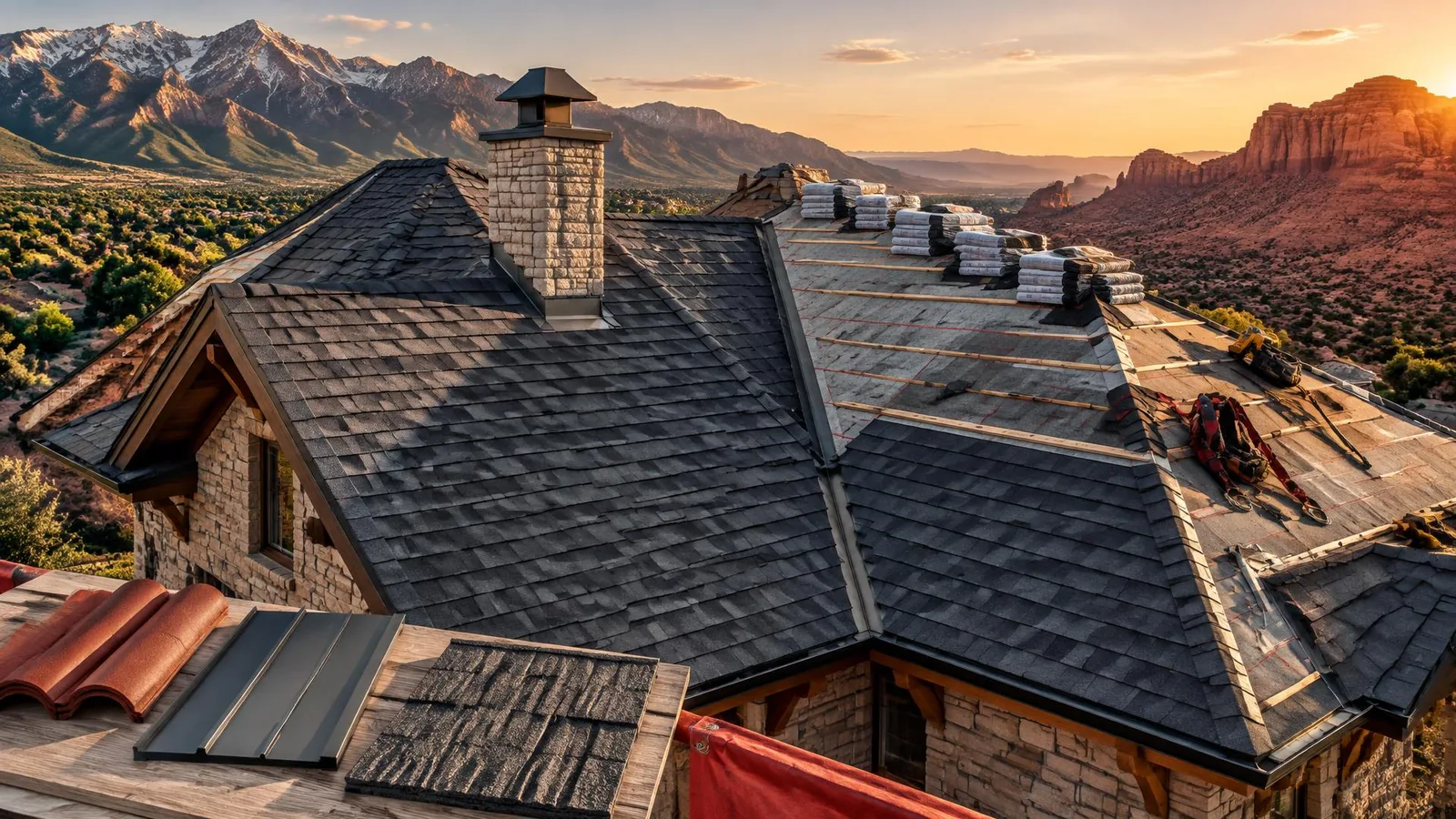
Most roofing websites say the same things. Licensed and insured. Quality workmanship. Free estimates. Serving the Wasatch Front. None of that is wrong, but none of it helps a homeowner in Sandy or Hurricane decide that you are the right crew for their roof.
Meanwhile, the most persuasive material a roofer has is sitting in a phone camera roll: tear-offs, rotted decking, flashing details, valleys, ridge vents, finished roofs at golden hour. Every completed job is proof of experience. Very few roofers turn that proof into pages that can be found, read and trusted.
This article explains how to turn real projects into content that helps buyers and supports search visibility, without inventing anything, exposing customers or building another stack of copy-and-paste city pages.
Why finished jobs carry more weight than another service page
A service page explains what you offer. A project page shows that you have actually done it, on a specific kind of house, with a specific material, under specific conditions. That difference matters to buyers and it lines up with how Google describes useful content.
Google's guidance on evaluating content talks about experience, expertise, authoritativeness and trust. It is worth being precise here: that is a framework for judging quality, not a single ranking score you can switch on with a badge or a paragraph. What it rewards in practice is content that clearly comes from people who did the work. A well documented roof replacement, with real photos and real decisions explained, is about as clear an example of firsthand experience as a contractor can publish.
Project pages also answer questions that service pages struggle with:
- What does a tile roof repair actually look like on a Southern Utah home?
- How do you handle a low-slope section over a garage?
- What happens when the decking is worse than expected?
- How long did a full replacement take on a two story home?
Homeowners search for those things, and they ask AI assistants about them. A page that answers them with evidence is more useful than a page that repeats "we do roof repair."
Utah roofing is not one market
A roofer working across Utah is dealing with very different conditions. Northern Utah roofs deal with snow load, ice, freeze and thaw cycles and seasonal storms. Southern Utah roofs face intense UV, long stretches of heat, monsoon wind and occasional hail, and tile and metal are common choices there.
That variety is an advantage for content. A shingle replacement in Sandy after a hard winter and a tile repair in St. George after a wind event are genuinely different jobs. Documenting both shows range and gives each market its own credible material.
Northridge Roofing & Exteriors, a contractor we work with, is a good illustration of the structure that makes this possible. Their site separates services (repair, replacement, storm damage, inspections, commercial), materials (asphalt shingles, metal, tile, stone-coated steel and flat or low-slope systems) and service areas across Northern and Southern Utah, with offices in Sandy and St. George. That kind of foundation gives every future project page obvious places to connect: the service performed, the material used and the area served.
What a strong roofing project page includes
A project page does not need to be long. It needs to be specific. Here is a structure we recommend.
Illustrative example only. The scenario below is invented to show the structure. It is not a real Northridge project or any other client's job.
| Section | What to include | Illustrative content |
|---|---|---|
| Title | Service, material and general area | Tile roof underlayment replacement on a Washington County home |
| The problem | What the homeowner noticed and why they called | Leaks near a valley after monsoon storms; cracked and slipped tiles |
| Roof type and material | Existing system and what was installed | Concrete tile, original underlayment past its useful life |
| Constraints | Anything that shaped the approach | Steep sections, HOA color rules, tiles that could be reused |
| Photos | Before, during and after, with captions | Lifted tiles, exposed underlayment, new battens, finished valley |
| Location scope | City or area only, never the street address | Washington County, Southern Utah |
| Decisions | What you chose and why | Reset existing tile on new underlayment instead of a full tile replacement |
| Result | Observable outcome, stated honestly | Valley rebuilt, tiles reset, homeowner reported no leaks after the next storm |
| Call to action | One clear next step | Request a tile roof inspection |
Notice what the illustrative result does not say. It does not claim a ranking, a percentage or a promise. It describes what was done and what the customer reported. That is the right standard for real projects too.
Captions do more work than you think
Photos without context are just pictures of roofs. A caption like "Rotted decking found under the second layer of shingles; we replaced 14 sheets before installing new underlayment" teaches the reader something and explains why the job cost what it did. Short, specific captions also make the page easier to skim and give search engines plain text that describes the image.
Answer the questions customers actually asked
The best project pages borrow from real conversations. If the homeowner asked whether they could stay in the house during the work, how noisy it would be, whether the HOA needed to approve the color, or how insurance documentation worked, answer those questions on the page in a sentence or two. Do not invent a long list of generic questions to fill space. Use the ones that came up on the job.
Respect privacy and get permission
Project content is built on someone's home, so treat it carefully.
- Get written permission before publishing photos of a customer's property, and before naming them or quoting them.
- Never publish street addresses. A city or area is enough. Avoid shots where house numbers, license plates or people's faces are visible unless you have explicit consent.
- Strip location data from photos. Phone photos often contain GPS coordinates in their metadata. Remove it before uploading.
- Keep insurance details private. Claim numbers, adjuster names and payout amounts do not belong on a public page.
- Only quote real feedback. If a customer leaves a review, you can reference it with permission. Never write a testimonial for them.
These rules protect customers and protect your reputation. They also keep you clear of the kind of claims that create problems later.
Service cities versus real office locations
This is where many roofing sites go wrong. A contractor serves twenty cities and creates twenty city pages that swap the city name into the same paragraphs. Worse, some of those pages imply an office or crew base that does not exist.
Projects give you a better approach. Instead of claiming to be "the Lehi roofing company" when your office is elsewhere, show the jobs you have completed in Lehi, Provo and the rest of Utah County. A service area page backed by real projects says something no template can: we have worked here, on houses like yours.
Be honest about where you are based. If your offices are in Sandy and St. George, say so. If you serve Hurricane, Washington and Cedar City from St. George, say that too. Customers understand service areas. What erodes trust is a page that implies a local office when the phone rings two hours away.
The same principle guides how we approach our own location pages, from SEO for Sandy businesses to St. George SEO services and our Utah County SEO planning page. Each one is written for buyers in that market without pretending to be something it is not.
Link projects to services and service areas
A project page is most valuable when it is connected to the rest of the site.
- Project to service. A roof replacement project should link to the roof replacement page. A storm damage project should link to the storm damage page.
- Project to material. If the job involved metal roofing, link to the metal roofing page so readers can learn more about the system.
- Project to service area. Link to the relevant city or regional page, and have that page feature a few recent projects in return.
- Service to projects. Each service page should show a handful of real jobs, so a reader comparing contractors can see evidence without hunting for it.
That web of links helps visitors move from "I have a problem" to "these people have solved it before" in a couple of clicks. It also helps search engines understand which pages relate to which services and places. Planning that structure is a core part of our content strategy work.
Google Business Profile still matters
Projects support your map presence too. Upload real job photos to your Google Business Profile regularly, and use the same honest captions. Encourage satisfied customers to leave reviews that mention the type of work done, without scripting their words. A consistent flow of real photos and real reviews supports the local signals that local SEO depends on.
Keep the profile accurate. Your address should be a real office, your service areas should match where you actually work, and your categories should reflect your main services.
Turn project pages into leads
A project page should make the next step obvious without becoming a sales pitch. One clear call to action is enough, matched to the job:
- A storm damage project might end with "Request a storm damage inspection."
- A tile repair project might end with "Have us look at your tile roof."
- A commercial low-slope project might end with "Request a commercial roof evaluation."
Include a phone number that works on mobile with one tap and a short form that does not ask for more than you need. Roofing buyers are often dealing with a leak or a deadline. Make it easy.
How to measure whether projects are working
Rankings alone will not tell you whether project content is paying off. Track a few specific signals:
- Search Console by page group. Filter the Performance report to your project URLs and watch impressions and clicks over time. Look at which queries bring people to each project. You may find searches you had never targeted.
- Query to page match. Check whether material and service searches in your markets start landing on project or service pages instead of your homepage.
- Lead actions on project pages. In GA4, track calls, form submissions and inspection requests that start on or pass through project pages.
- Lead source in your CRM. Ask how customers found you and record it. When someone says "I saw the tile job you did in Washington," that is a project page working.
- Booked jobs, not just leads. The goal is signed work. Track which lead sources turn into inspections and contracts.
Give it time. A handful of project pages will not change much in a month. A steady habit of documenting two or three good jobs a month builds a library that compounds over a season.
What this looked like for Northridge
Northridge Roofing & Exteriors became a client in fall 2025. We rebuilt their website and strengthened their SEO around services, local markets, internal linking, technical quality and content that reflects the team's real construction experience. Our Northridge Roofing case study documents strong organic positions for competitive roofing searches in several Utah cities, including Hurricane, Santa Clara and Ivins. Separately, the client has publicly described improved rankings, more calls and leads, and the rebuilt website as meaningful benefits of the work. We present those as two different kinds of evidence: search visibility we documented, and business results the client reported.
Start with your next three jobs
You do not need to backfill years of work before this pays off. Start with your next three jobs.
- Ask the homeowner for permission to document the project.
- Take before, during and after photos with the details that matter: decking, flashing, valleys, ventilation and the finished roof.
- Write down the problem, the material, the constraints and the decisions while they are fresh.
- Publish a short project page, link it to the right service, material and area pages, and add the photos to your Google Business Profile.
If you want help building a project content system that fits your services and markets, see how we work with roofing companies and other home service contractors, or schedule a consultation and we will walk through your site, your markets and the jobs you are proudest of.