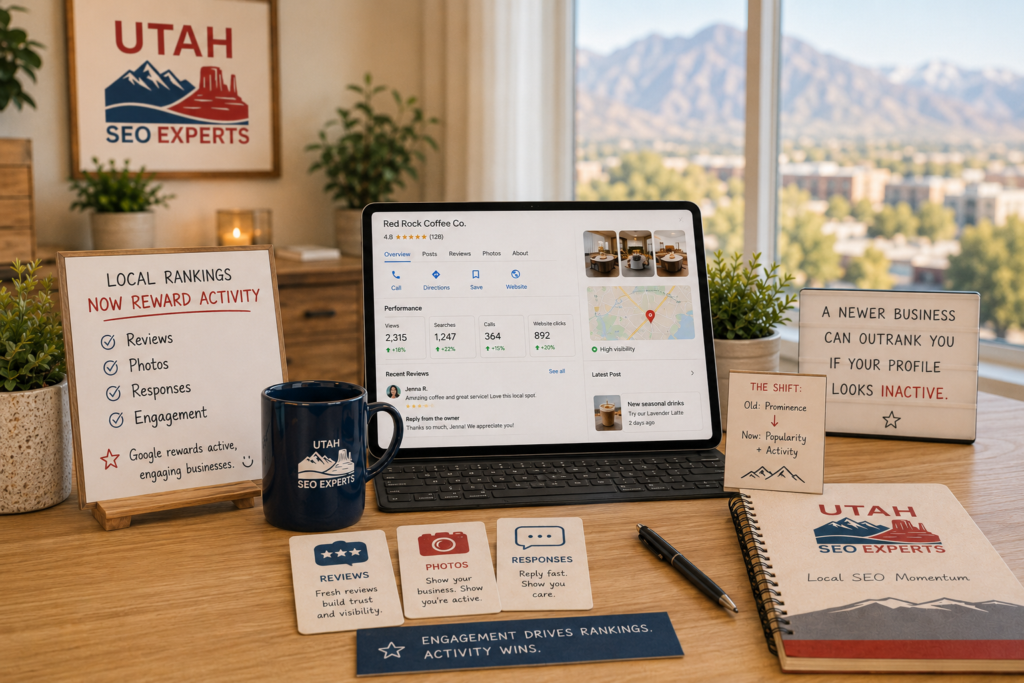
Why a Newer Utah Business Can Outrank an Established Competitor Almost Overnight
For years, local SEO has been explained through three main Google ranking factors: relevance, distance, and prominence.
Relevance meant your business matched what the person searched for. Distance meant you were close enough to the searcher or the city being searched. Prominence meant Google understood your business as established, trusted, and well-known.
That framework still matters.
But there has been an important shift in how local search feels in the real world.
Google’s own documentation now describes local results as being based mainly on relevance, distance, and popularity. That word matters.
Popularity is not exactly the same as being old, established, or historically reputable. A business can have ten years of experience, dozens of happy customers, and a strong reputation offline, but if its Google Business Profile looks inactive, outdated, or ignored, it may not look “popular” to Google right now.
That is why a newer roofer, dentist, med spa, attorney, HVAC company, or contractor in Utah can sometimes outrank a business that has been around much longer.
Not because the newer business is better.
Because the newer business looks more active, more engaging, and more trusted in the current local search environment.
Your Years in Business Do Not Automatically Protect Your Rankings
A lot of Utah business owners assume their local rankings are protected because they have been around for a long time.
They think:
“We have been in business for 10 years.”
“We have more experience than that competitor.”
“Everyone in town knows us.”
“We have plenty of past customers.”
“We have a real office, real employees, and a real reputation.”
All of that matters for your business. But Google cannot rank you based only on what people offline know about you.
Google ranks what it can understand, measure, and compare.
If your Google Business Profile has not had a new photo in months, has unanswered reviews, has old service information, has weak categories, has little recent activity, and does not inspire users to click, call, request directions, or engage, Google may not see the same strong business that your customers see.
To Google, an inactive profile can look like a quiet business.
And quiet does not usually win in local search.
The Shift from “Established” to “Active”
The old way many businesses thought about local SEO was simple:
Get listed.
Get verified.
Get some reviews.
Build a decent website.
Wait for rankings.
That may have worked better years ago when many competitors were barely paying attention to Google Business Profile optimization.
Today, local SEO is much more active.
Google is trying to show searchers the business that appears to be the best match right now. That means current signals matter.
A competitor who opened last year may be sending stronger current signals than a business that opened ten years ago.
For example, imagine two roofing companies in St. George.
Company A has been in business for 12 years. It has a decent website, a verified Google Business Profile, and 75 reviews. But it rarely adds photos, does not respond to most reviews, has no recent posts, and has not updated its services in a long time.
Company B opened last year. It has 38 reviews, but most of them are recent. The owner responds to every review. The company uploads project photos every week. Their profile has clear services, strong categories, fresh content, updated hours, and users are actively clicking, calling, and requesting estimates.
Even though Company A is older, Company B may look more alive to Google.
That is the problem.
Your history matters, but your current visibility signals matter too.
What “Popularity” Means in Local SEO
When Google talks about popularity or prominence, it is not only talking about who is famous.
For a local business, popularity can be influenced by signals like:
Recent reviews
Positive ratings
Review responses
Profile completeness
Photos and videos
Local brand searches
Clicks from search results
Calls from Google Business Profile
Direction requests
Website visits from the profile
User engagement
Mentions across the web
Local links
Consistent business information
Relevant website content
In other words, Google is trying to understand whether people are choosing, trusting, and interacting with your business.
That creates a major opportunity for smaller and newer companies.
It also creates a major risk for older companies that have gotten comfortable.
A Dead Google Business Profile Can Make a Good Business Look Weak
This is where a lot of Utah businesses are vulnerable.
They may be excellent at what they do, but their online presence does not show it.
A dentist may have a great patient base but only a handful of recent reviews.
A roofer may complete beautiful projects but never upload job photos.
A plumber may have strong word-of-mouth referrals but an outdated Google Business Profile.
A law firm may have years of experience but no consistent local content or review strategy.
A med spa may have loyal clients but weak service descriptions and no fresh profile activity.
A home service company may be busy in the field but invisible in Google Maps.
The business is not dead.
But the profile looks dead.
And in local SEO, perception matters.
When Google is comparing multiple businesses in the same city or service area, a stale profile can lose to an active competitor.
Reviews Are No Longer Just a Reputation Asset
Reviews used to be thought of mostly as social proof.
A customer checks your reviews, likes what they see, and decides to call.
That is still true.
But reviews also help Google understand your business.
Reviews can reinforce your services, your location, your customer experience, and your trustworthiness. When customers mention things like “roof repair in Hurricane,” “emergency plumber in Orem,” “best dentist in Lehi,” or “HVAC replacement in St. George,” that language gives Google more context.
This does not mean you should coach customers to stuff keywords into reviews. That is not the point.
The point is that real customer language helps Google understand what your business does and where you do it.
Just as important, recent reviews show momentum.
A business with 200 reviews but only two new reviews in the last year may not look as active as a competitor with fewer total reviews but consistent new reviews every month.
Total review count still matters.
But review velocity matters too.
Review Responses Are an Underrated Local SEO Signal
Responding to reviews is not just customer service.
It shows that the business is active.
It also gives you another chance to reinforce your services, your location, and your brand voice in a natural way.
For example, a weak review response says:
“Thanks!”
A stronger response says:
“Thank you for choosing our team for your roof repair in St. George. We appreciate the opportunity to help and are glad you had a great experience.”
That type of response is better for the customer, better for future prospects, and better for Google’s understanding of the business.
Every review response should sound human. It should not be spammy. But it should be specific enough to show what the business actually did.
Photos and Videos Help Prove You Are Active
For many local businesses, photos are one of the easiest missed opportunities.
Google Business Profile photos can show:
Recent projects
Team members
Office or storefront
Service vehicles
Before and after work
Equipment
Products
Completed jobs
Customer experience
Community involvement
For Utah contractors, dentists, med spas, attorneys, restaurants, gyms, and home service companies, photos help prove that the business is real and active.
A roofing company should show recent roofs.
A dentist should show the office, team, and patient experience.
An HVAC company should show installs, trucks, technicians, and service work.
A med spa should show treatment rooms, providers, and educational visuals.
A local attorney should show the office, team, community involvement, and professional presence.
You do not need to overcomplicate this. You just need consistency.
A few strong photos every week can make a profile feel alive.
Google Business Profile Is Not a Set-It-and-Forget-It Asset
One of the biggest mistakes businesses make is treating their Google Business Profile like a directory listing.
They verify it once and forget it.
That is not enough anymore.
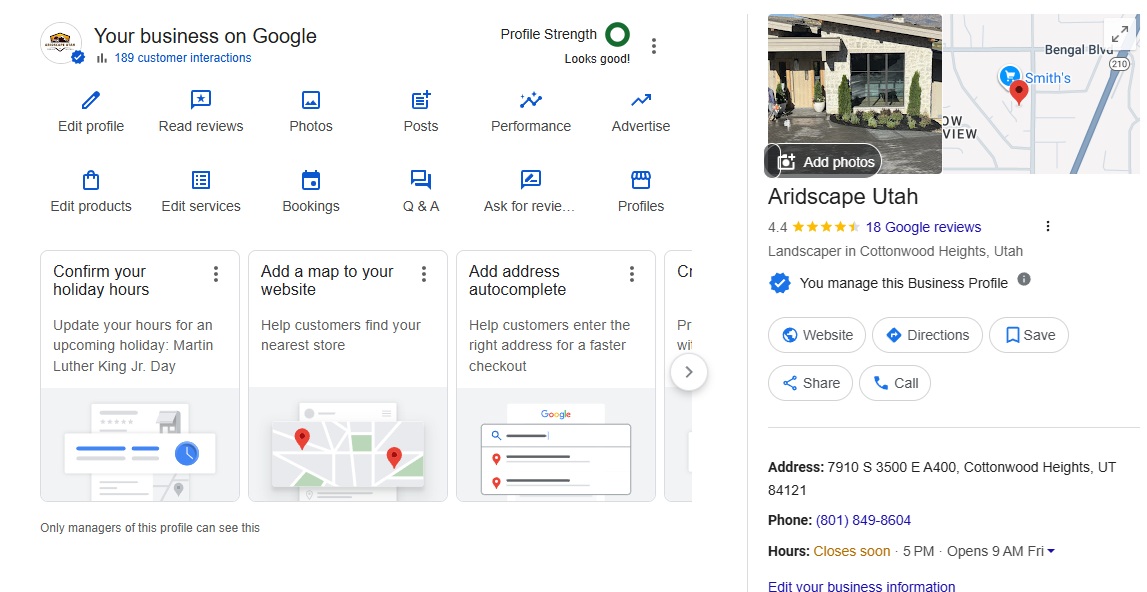
Your Google Business Profile should be managed like a living local search asset.
That means:
Your categories should be reviewed.
Your services should be complete.
Your business description should be accurate.
Your hours should be current.
Your photos should be updated.
Your reviews should be answered.
Your Q&A section should be monitored.
Your appointment, booking, and website links should work.
Your service areas should make sense.
Your products or services should match what you actually want to rank for.
Your profile should support the same strategy as your website.
A strong Google Business Profile and a strong website should work together.
If your profile says one thing and your website says another, you create confusion. If both clearly support your primary services and locations, you make it easier for Google to trust and rank you.
Newer Competitors Can Move Faster Than Established Businesses
This is the part that frustrates many established businesses.
A newer competitor may not have your experience, your team, your customer base, or your history.
But they may be paying more attention.
They may be asking every happy customer for a review.
They may be uploading fresh photos from every job.
They may be responding quickly.
They may be posting updates.
They may be building service pages.
They may be earning local links.
They may be improving their website.
They may be tracking what drives calls.
They may be actively managing their search presence every week.
That activity compounds.
Local SEO rewards consistency.
The business that keeps showing Google fresh signals often has an advantage over the business that only relies on past reputation.
This Matters Even More in Competitive Utah Markets
Utah local search is not getting easier.
In fast-growing areas like Lehi, Orem, Provo, Draper, Sandy, South Jordan, Riverton, Herriman, St. George, Washington, Hurricane, and Cedar City, more businesses are competing for the same local searches.
A roofer in St. George is not only competing with roofers in St. George. They may be competing across Washington, Hurricane, Santa Clara, Ivins, and the broader Southern Utah market.
A dentist in Lehi may be competing with offices in American Fork, Saratoga Springs, Highland, Eagle Mountain, and Draper.
A plumber in Orem may need visibility across Utah County.
A med spa in Sandy may be fighting for searches across Salt Lake County.
This is why an inactive Google Business Profile is such a problem.
In a low-competition market, you might get away with neglecting it.
In a competitive Utah market, you probably will not.
What Utah Businesses Should Do Now
If your business depends on local leads, your Google Business Profile needs ongoing attention.
Start with the basics.
Make sure your name, address, phone number, website, hours, and categories are accurate. Add every major service that matters to your business. Make sure your service areas are realistic. Review your photos and remove anything outdated or low quality. Add new photos that show your actual team, work, location, and customer experience.
Then build a review process.
Do not wait for reviews to happen randomly. Ask happy customers consistently. Make it easy for them. Respond to every review. Use natural language. Be specific. Be professional. Be grateful.
Next, connect your profile to your website strategy.
If you want to rank for “roof repair in St. George,” your Google Business Profile, website content, service pages, internal links, title tags, and reviews should all support that topic. If you want to rank for “dentist in Lehi,” your website and profile should make that clear.
Then keep going.
Local SEO is not one big task. It is a rhythm.
A Simple Weekly Google Business Profile Routine
For many businesses, a simple weekly routine can make a major difference.
Add new photos.
Respond to new reviews.
Check for profile edits or suggested changes.
Review calls, clicks, and direction requests.
Publish a short update when useful.
Add new services or details when your offerings change.
Look at which searches are showing your profile.
Compare your profile to the competitors ranking above you.
This does not need to take hours every week.
But it does need to happen.
The businesses that win in Google Maps are usually not the ones that touched their profile once and forgot about it. They are the ones treating local visibility as part of their ongoing marketing system.
Popularity Does Not Mean Chasing Gimmicks
This does not mean you should try to manipulate Google.
It does not mean fake reviews, keyword-stuffed business names, spammy posts, or low-quality tactics.
Those shortcuts can create bigger problems.
Real popularity comes from real signals.
Real customers.
Real reviews.
Real photos.
Real service pages.
Real local authority.
Real engagement.
Real consistency.
That is the kind of popularity Google is trying to understand.
The good news is that legitimate businesses can win with this approach. You do not need tricks. You need a better system.
The Big Takeaway
Your decade of reputation still matters.
But it does not protect you if your online presence looks inactive.
Google is not only looking at who has been around the longest. It is looking at which business appears to be the best, most relevant, most trusted, and most active option for the searcher right now.
That means a newer competitor can outrank you faster than you think.
It also means you can fight back.
If your business has real experience, real customers, and a real reputation, your Google Business Profile and website should reflect that. The goal is not to look busy. The goal is to make your real-world credibility visible to Google and to the customers searching for you.
At Utah SEO Experts, we help Utah businesses improve Google Maps rankings, local SEO visibility, website content, reviews, and AI search readiness through a strategy built around how search works today.
If your Google Business Profile has been neglected, now is the time to fix it.
Because in local SEO, the business that looks alive often beats the business that is simply established.