
Rankings don’t happen without a solid on-page foundation. You can build links, publish content, and run ads, but if your pages aren’t structured correctly, search engines won’t understand what you’re about, who you serve, or why you deserve to rank above the next result. On-page SEO is where every campaign at Utah SEO Experts starts, and it’s where most of the fixable problems live when we audit an underperforming site.
This isn’t about stuffing a keyword into a title tag and calling it done. On-page optimization in 2025 and into 2026 means satisfying Google’s quality signals, earning citations in AI-generated answers, and making it genuinely easy for both search engines and real people to understand what a page is about and why it should be trusted.









On-page SEO is the set of optimizations you apply directly to a webpage to help search engines and users understand its content, relevance, and authority. Unlike off-page SEO, which depends on external signals like backlinks, on-page factors are fully within your control. That makes them the most efficient place to improve a site before spending time or money on anything else.
The major on-page factors Utah SEO Experts addresses on every campaign include title tags and meta descriptions, heading structure (H1 through H3+), body content quality and topical depth, keyword placement and semantic relevance, internal linking, image optimization, schema markup, and page-level signals like URL structure and canonical tags. Each of these factors communicates something specific to search engines. When they’re aligned, rankings follow. When they’re inconsistent or ignored, even strong external link profiles can stall out.
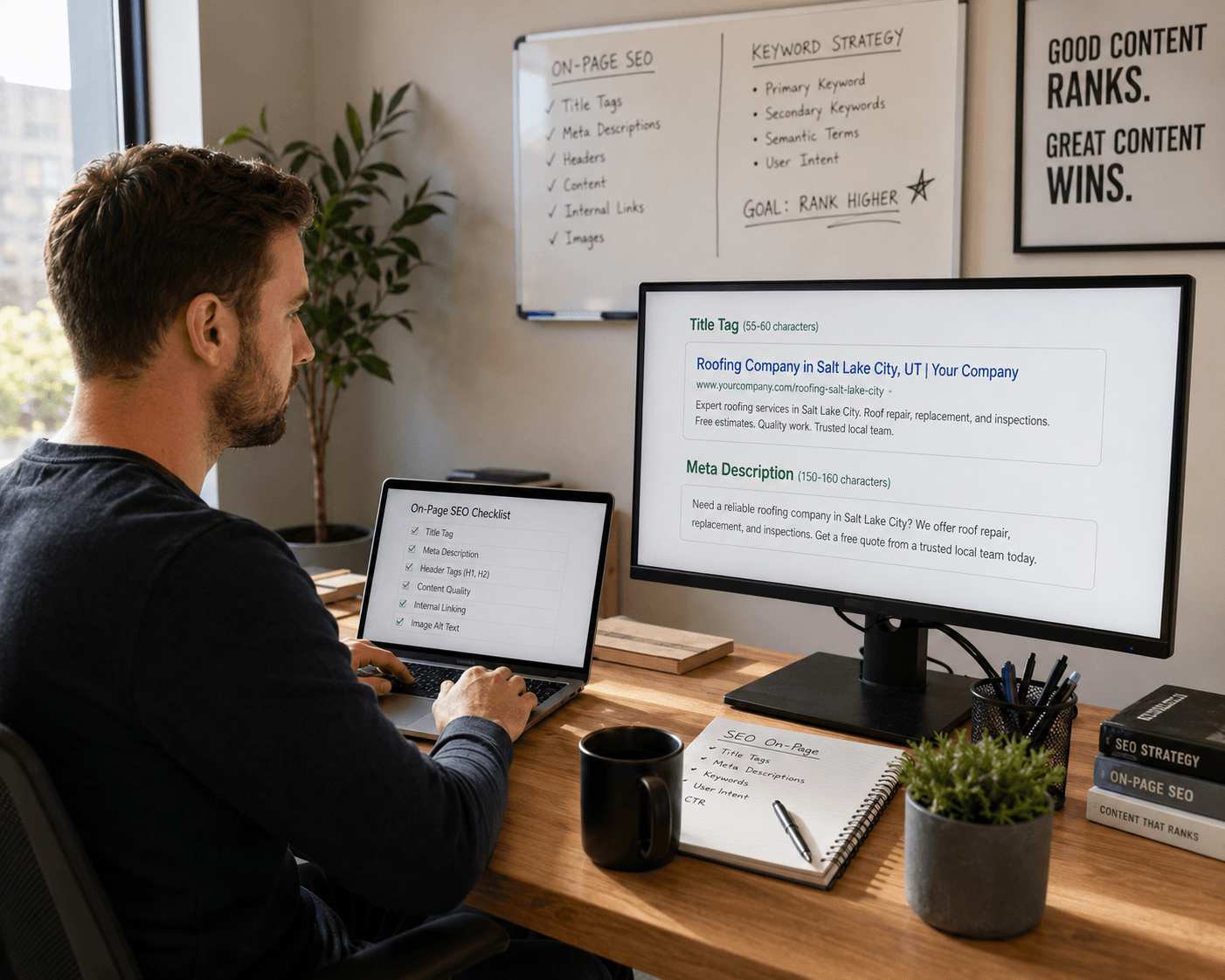
The title tag remains one of the highest-weight on-page signals in Google’s algorithm. It tells the search engine the primary topic of the page and appears as the clickable headline in the search result, so it has to serve two audiences simultaneously: the crawler and the human deciding whether to click.
A properly optimized title tag for a Utah business includes the primary keyword, a geographic qualifier where appropriate, and brand name. It stays within 55 to 60 characters so it renders fully in search results without truncation. Vague or generic title tags are one of the most common fixable problems we see on audits, and getting them right often produces ranking movement within a few weeks of recrawl.
Meta descriptions don’t directly influence rankings, but they influence click-through rate, which does. A well-written meta description gives a searcher a specific reason to choose your result over the four others on the page. We write them to match search intent, reinforce the keyword theme, and include a clear action signal, all within 150 to 160 characters.
Proper heading hierarchy is how search engines map the topical structure of a page. The H1 defines the page’s primary subject. H2s represent major subtopics. H3s drill into specifics under each H2. When headings are used correctly, a crawler can extract the page’s full semantic outline without reading every word. When they’re used arbitrarily for visual style, that clarity disappears.
Semantic SEO goes beyond putting the target keyword in the right place. It means covering the topic thoroughly enough that related terms, entities, and subtopics appear naturally throughout the content. Google’s understanding of language has become sophisticated enough that keyword density as a tactic is obsolete. What matters now is topical completeness: does this page answer the full range of questions a searcher might have on this subject? Does it demonstrate real knowledge, or is it surface-level content that any generic writer could produce without knowing anything about the industry?
For Utah businesses, that specificity often means naming real local contexts, neighborhoods, service areas, or industry-specific situations rather than writing generic copy that could apply anywhere. A Utah dental practice optimizing for implants needs content that reflects actual patient questions, local competition, and the specific procedures offered, not a generic article about what dental implants are.
Internal linking is one of the most underused on-page levers in most Utah websites we audit. Every internal link is a signal: it tells search engines which pages are important, how content is related, and what anchor text describes the linked page’s topic. Done well, internal linking distributes authority across a site, supports crawlability, and helps Google understand your topical architecture.
Utah SEO Experts builds internal link structures around deliberate silo architecture. Your main Utah SEO services page passes authority down to sub-silo pages, which pass it to city and industry-specific pages. Anchor text is specific and keyword-rich where appropriate, not generic placeholder language. This structure is especially important for larger sites and enterprise SEO campaigns where hundreds of pages need to work together as a coherent system.
Schema markup is machine-readable code added to a page’s HTML that tells search engines exactly what type of content is present and what it means. A local business schema tells Google your name, address, phone number, hours, and service area. A FAQ schema makes your questions eligible for rich results directly in the SERP. A review schema can surface star ratings. An article schema signals authorship and publication date.
Schema has become more important, not less, as AI-generated search results become standard. Google’s AI Overviews and tools like ChatGPT Search and Perplexity pull structured information directly from pages that make their content easy to parse. Pages with clean, complete schema are more likely to be cited as sources. Utah SEO Experts implements schema at the page level on every optimized property, including LocalBusiness, Service, FAQPage, BreadcrumbList, and Article schema with proper author attribution. For clients where AI search visibility matters as a separate goal, we coordinate that work with our dedicated AI Search Optimization service.
Google’s quality guidance since late 2022 has consistently pushed in one direction: reward content that demonstrates first-hand experience, subject matter expertise, and genuine usefulness. That’s the E-E-A-T framework (Experience, Expertise, Authoritativeness, Trustworthiness), and it has real implications for how pages are written and structured.
AI answer engines operate on similar logic. ChatGPT Search, Perplexity, and Google’s AI Overviews preferentially cite pages that open major sections with clear declarative answers, make specific and verifiable claims, and attribute content to identifiable authors with real credentials. Generic, vague, or keyword-stuffed pages get ignored by these systems entirely.
The on-page approach at Utah SEO Experts is built around this reality. We write content that leads key sections with direct answers, uses specific data and local examples, and maintains a consistent author voice that search engines can associate with a real person and a real track record. This isn’t a workaround or a tactic; it’s the direction search has been moving for years and where it will continue to go.
In six months between November 2025 and May 2026, Utah SEO Experts built a roofing company from zero online presence to ranking for 257 competitive phrases across 30 Utah cities. That campaign started with a new website, which meant on-page architecture decisions made at the beginning of the project determined what was possible six months later. Title tag structure, heading hierarchy, schema implementation, internal link architecture, and content depth were all set correctly from day one, which is why the timeline compressed as quickly as it did.
Most existing Utah businesses we work with have a site already in place but haven’t had their on-page elements systematically addressed. An audit typically surfaces title tag issues, thin or duplicate content, missing schema, broken internal link flows, and heading structures that don’t match what the page is trying to rank for. Fixing those issues is the fastest path to movement before any external work begins.
We’ve been running on-page audits and optimization campaigns in Utah since 2009, first through Be Locally SEO (founded 2009, sold 2018) and now through Utah SEO Experts since 2021. That continuous experience across hundreds of Utah campaigns, covering industries from roofing and general contracting to law firms and med spas, is what informs how we approach every on-page decision. Every client gets that depth of attention on their specific account, not a templated checklist handed off to an overloaded account manager running 20 other campaigns simultaneously.
If your Utah website isn’t ranking where it should, the on-page foundation is the right place to start. Contact Utah SEO Experts to get a straight assessment of where your pages stand and what it will take to fix them.

On-page SEO does not stop at adding keywords to a page. Businesses need website content, page structure, headings, metadata, internal links, image details, schema, and user experience signals working together across the pages that matter most. A website may need stronger optimization for service pages, location pages, product pages, blog content, landing pages, and AI-powered search results.
At Utah SEO Experts, we build on-page SEO strategies around how people search, read, compare, and take action on your website. That means improving title tags, meta descriptions, headings, content quality, keyword placement, internal linking, URL structure, image optimization, schema markup, and page-level search signals that help Google better understand your content.
Our team works with local businesses, service companies, ecommerce websites, multi-location brands, professional firms, and organizations that need cleaner, stronger, and more search-friendly website pages. From Utah businesses improving existing pages to growing companies building new SEO content at scale, we help create on-page strategies that are organized, useful, and built for long-term visibility.
If your website needs stronger page-level visibility across services, locations, products, or search channels, your on-page SEO strategy should be built around the content, keywords, structure, and customer journeys that matter most. Schedule a consultation with Utah SEO Experts to discuss how we can help your business grow through on-page SEO.
Explore some of the Utah markets where we help businesses improve on-page search visibility:
On-page SEO refers to the optimizations applied directly to a webpage to help search engines understand its topic, relevance, and credibility. For Utah businesses, it determines whether pages rank for the right keywords in the right cities. Without a strong on-page foundation, external link building and content marketing produce far less return because search engines can’t accurately interpret what you’re offering or who you serve.
Most on-page changes become visible in search results after Google recrawls and reindexes the affected pages, which typically takes two to six weeks depending on your site’s crawl frequency. Title tag and meta description fixes often produce the fastest movement. Content depth and schema improvements tend to compound over a longer period as Google processes the updated signals and adjusts rankings accordingly.
On-page SEO addresses content-level signals: title tags, headings, body copy, schema markup, internal links, and keyword relevance on individual pages. Technical SEO addresses site-wide infrastructure: crawlability, indexation, site speed, mobile usability, Core Web Vitals, and server-side configuration. Both disciplines are necessary, and Utah SEO Experts treats them as complementary parts of a complete Utah SEO strategy rather than separate products.
It depends on the size of the site. A local Utah business with 15 to 30 pages gets a full page-by-page audit of every element. A larger site with hundreds of pages gets a systematic audit that prioritizes high-value commercial and service pages first, then expands from there. Utah SEO Experts delivers audit findings with prioritized recommendations, not a raw spreadsheet requiring interpretation.
Both. The initial audit and optimization pass is a one-time foundation build. Ongoing on-page work involves updating content as search intent shifts, adding new pages as you expand services or cities, refreshing schema as your business information changes, and improving internal linking as the site grows. Most competitive Utah markets require at least periodic on-page maintenance to hold and extend rankings over time.
The schema types we implement depend on the page and business type, but commonly include LocalBusiness, Service, FAQPage, BreadcrumbList, Article with Author markup, and Review schema where applicable. For e-commerce clients, we also implement Product and Offer schema. Every schema implementation is validated against Google’s Rich Results Test and kept current with evolving structured data guidelines.